Boa constrictors can grow to 3mtrs (although I have never had one grow larger than 2mtrs) and Rainbow Boas 1.5mtrs . They all come from South America so they need a home to match the conditions in that country.
Until they are two years old the vivarium size need be no larger than 2΄ square. This home must have ventilation but no hole big enough for the baby snake to escape from, most first problems arise from snakes escaping. They sometimes escape by pushing between the two glass doors so check that there isn’t room for the snake to escape that way. Glass tanks are never advisable as temps cannot be controlled properly, a wooden vivarium with glass sliding doors is the best habitat.
Hemp, Aspen or Orchid bark are all suitable substrates, these snakes need a some humidity so substrate that doesn’t go mouldy is essential. This can be spot cleaned for about two months or until you think the whole lot needs throwing out and start with fresh. There are recommended cleansing fluids available from reptile shops, some pet shops and from Veterinary Surgeries. At the sanctuary we use the best F10.
Dependant on their appetite and growth rate a new home would probably be needed in about 2 to 3 years. The size needed when the snake is about 5 years old would be approx. 6΄ x 2΄ x 2 ΄ personally I prefer to give a snake as much room as possible for stretching, with plenty of furniture and hides.
Various heat sources are available and whilst the snake is young a heat-mat placed underneath the vivarium but with an airspace which means putting the viv. on top of two small plinths either side to lift it a little so that it does not rest on the mat. Alternatively you could stick the mat onto the side or the back of the viv. With packing tape. There are other forms of heating equipment, which although more expensive are safer, as heatmats can be a fire hazard (they are not supposed to be left on indefinitely) If I use heatmats I always keep them on a timer. In the larger vivarium it will be necessary to purchase a ceramic heater with casing to prevent the snake from burning itself by wrapping around it. the heater needs to be able to keep a stable temp of 29c in the hot spot, I ususally purchase a 250watt ceramic heater for this purpose also a Habistat temperature regulator is absolutely necessary; no extra light is necessary if the snake is in a normally lit room, light bulbs also give off heat so the vivarium may become too hot and a snake can wrap itself around an unprotected bulb and burn itself. If you do decide to use a light or heat bulb it should be covered with a metal cage so that the snake cannot wrap around it. A thermometer (preferably digital) is necessary to keep an eye on the temperature which can range between 21 cool end, 30c warm end.
The baby snakes will eat rat pups every 10 to 14 days. As the snake grows you need to increase the size of the food to weamer rats and then later moving on to larger rats, an adult snake can eat quite a couple of large rats about once a month, these can be bought frozen and I would always advise to defrost at room temperature, not to use a microwave. You can also buy vitamin supplements from the sources already mentioned.
Do not worry unduly if the snake does not eat, a snake can go without food for up to four months. Only be concerned if the snake looks under the weather.
Some snakes will still eat even when going into a slough (skin shed) most will not. You will know when the snake is going to shed, first its eyes go grey and milky and the skin becomes duller or darker.
Handle your snake often as this will make it more sociable, except when it has just eaten, as it may regurgitate (be sick), leave the snake at least 5 days to rest after its meal and when it’s sloughing. Clean water must always be available, a bowl large enough for the snake to bathe in if it wants. I try, always, to give my snakes two bowls, one for bathing and a smaller one for drinking, a lid on the bathing bowl with an entrance hole makes it more attractive as then it becomes a hiding place too, I find Boas love to bathe. Sometimes a light misting with water is also appreciated.
Boas like a very slightly humid environment so it’s necessary to give the snake a box, with its lid, but with a hole cut into the lid big enough for the snake to go in, fill with damp peat and moss, this is especially appreciated when the snake is in slough (skin shedding). By the 4th or 5th year the snake will become sexually mature, as the snake grows older it will often go without food for two months or more at mating time, especially male snakes, don’t worry. But if you do, you can always ring me.
If you keep two snakes together never feed them together, an awful accident can happen where both snakes go for the same food. Take one snake out of the vivarium and feed them separately.
Never touch their food with your fingers and then place your hand near the snake, it will probably think your hand is its food and bite it by mistake. Always use tweezers or some other tool to pick up the snakes food.
It can be a good idea to keep a separate container for feeding the snake, as it will get used to this idea and never think that a hand is the food coming into its house
Mites can sometimes appear on your snake, the eggs are as small as dust so they can be picked up in reptile shops or anywhere where there are other snakes. If you notice your snake lying in it’s water bowl all the time, it may be trying to drown the mites and you will notice the little black insects on it’s body and in the water. Put the snake overnight in a box, with a lid and airholes, half full of tepid water (refer to viv temps) put a smear of vegetable oil on the snakes face as the mites can migrate there but cannot live in oil. Clean the viv with reputable cleansing fluid, pour boiling water over the furniture in the viv i.e. the bowl, bark etc. Then replace everything including the snake, the next day. Continue to keep an eye on your snake as these insects suck their blood, can make the snake very ill and even kill it.
Keep a look out in the shop where you buy reptile food and accessories, as this is the most common place to pick them up, the eggs are like dust.
If your snake brings up it’s food (regurgitation) don’t feed it again for two weeks as it’s stomach will be sore and it could make the snake ill.
Boas are one of my favourite snakes as they do get to know you and can make a really lovely animal companion, especially when they whisper in your ear.
P.S. This is a general care sheet for all types of Boa
Always try to imagine how you would feel in the same circumstance as the snake, e.g. left all alone for days without sensing anything different, no wind, rain, sunshine. They can be very sensitive to the slightest movement or vibration and become nervous, without stimulation.
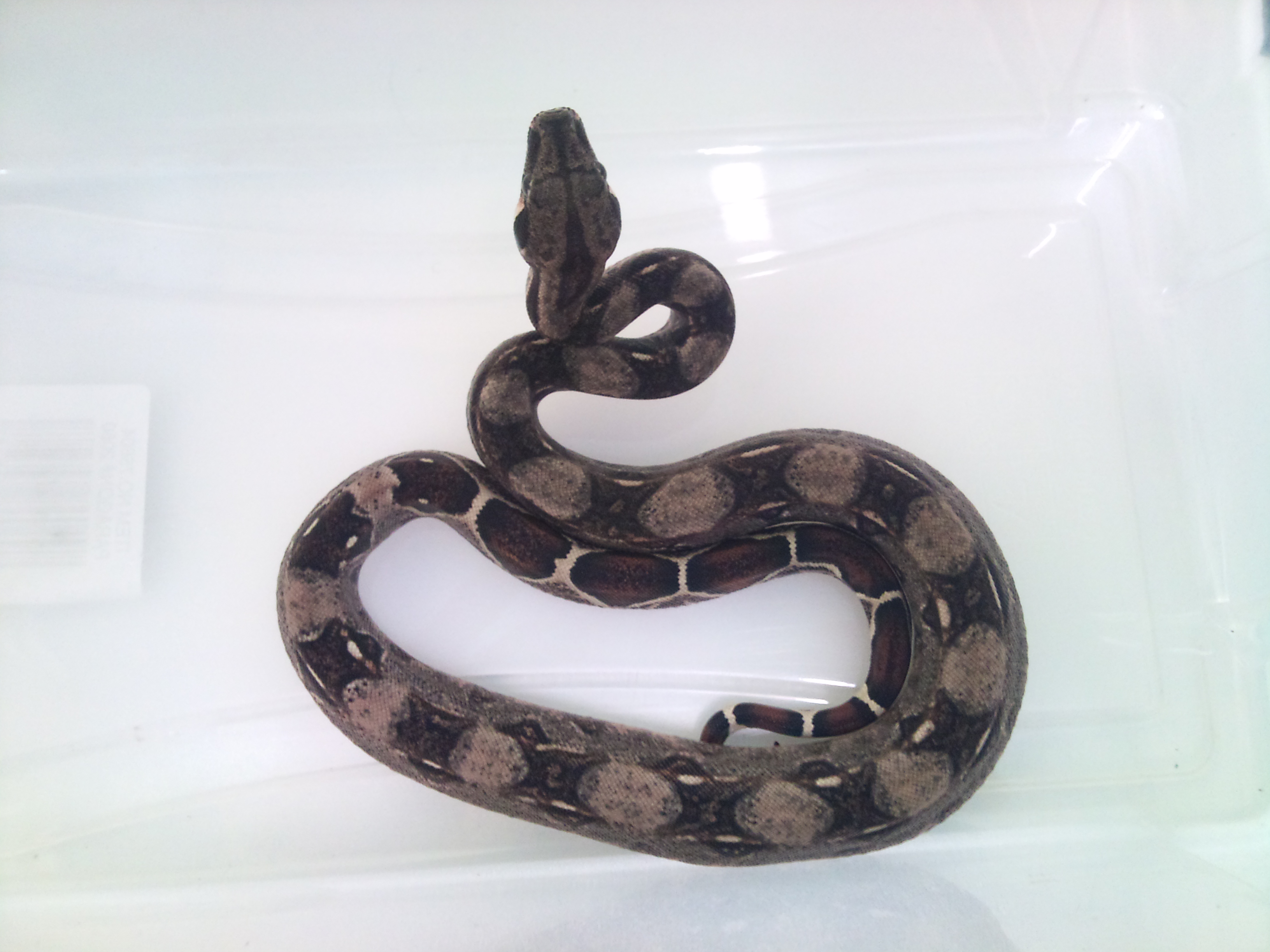
One of the female rescue boas had babies, Boas produce live young so we now have some for sale and looking for good homes.